Computers run hot. Buildings need heat.
DH System turns the waste heat of high-performance computing into heating and hot water for the building it sits in — powered by the roof's solar panels, plugged into the boiler that is already there. We install and operate the compute module as a service under a yearly contract, so a rented building gets a heating system that raises its yield instead of consuming its capital.
Two energy problems that happen to be the same shape
Switzerland has to get fossil fuels out of its boiler rooms. At the same time, the world is building computing capacity at a pace never seen before — and throwing its heat into the sky.
Heating is still fossil
37 % of buildings are heated with oil and 17 % with gas; among households the fossil share is closer to two thirds. The go-to replacement, the heat pump, costs around CHF 40,000 for a single house, needs an outdoor unit, refrigerants and permits, and loses efficiency on the high-temperature radiators most older buildings have. For the owner of a rented building it is capital tied up for decades — subsidies help, but only if the old system is ripped out, and they cannot carry a national transition on their own.
Computing throws its heat away
That is about 1.5 % of the world's electricity, and the IEA expects it to more than double to around 945 TWh by 2030 as AI workloads grow. Almost every one of those kilowatt-hours ends up as low-grade heat that is fanned into the atmosphere — often after spending even more energy on cooling. Meanwhile, buildings a few kilometres away burn gas to make exactly that heat.
Put the compute where the heat is wanted, and both problems shrink at once.
A compute module in the boiler room
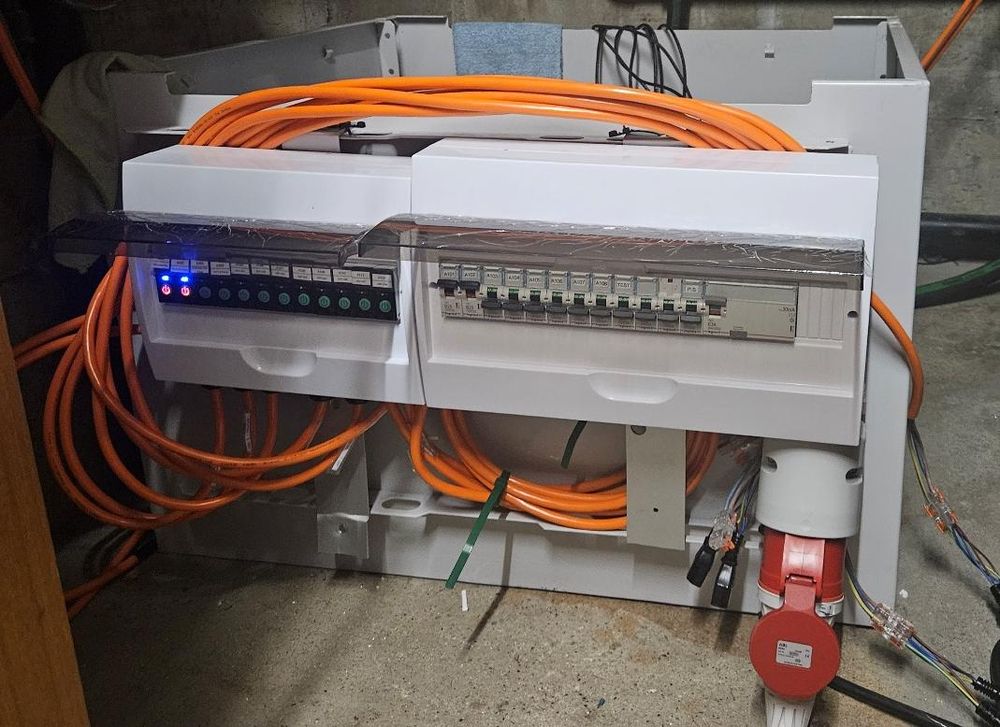
The DH System is a compact, immersion-cooled compute module that stands next to the existing boiler. The chips inside — today Bitcoin ASICs, next GPUs for AI and HPC — turn electricity into heat with better than 99 % efficiency. Plate heat exchangers move that heat into the radiators and the hot-water tank at 55 °C. No outdoor unit, no refrigerants, no change to the radiators.
When the sun shines, the module runs on the roof's solar power and every kilowatt-hour spent computing heats the building. When it doesn't, the boiler already in place takes over — a hybrid that cut fossil consumption by 45 % in our pilot building. The module is delivered as a service: DH System owns, installs, monitors and replaces it under a yearly contract, runs the compute and carries its market risk, and pays the building a cashback of about 4 ct/kWh on solar-powered heating hours. The owner never touches hardware or cryptocurrency — and never writes the cheque for a heat pump.
Solar first
The controller runs the module when the panels produce. Heat is made from the building's own electricity instead of being exported at a few cents a kilowatt-hour.
55 °C, boiler-grade
Immersion cooling and brazed plate exchangers deliver 55 °C supply water — enough for existing radiators and domestic hot water, and a temperature heat pumps only reach at a steep efficiency penalty.
Swap the chips, keep the plumbing
Hydraulics stay for decades; compute is upgraded every few years — by us, under the contract. The module is designed so the workload can change from ASICs to GPUs without touching the building.
| Criterion | Air-source heat pump | DH System as a service |
|---|---|---|
| Upfront investment | ≈ CHF 40,000 for the unit on a single house; ≈ CHF 72,000 with solar after subsidies | None — the module is owned and installed by DH System under a yearly contract |
| Payback | Decades on high-temperature radiators — the saving against gas is small | No payback needed: the building is cash-positive from the first year |
| Existing radiators | Efficiency (COP) drops sharply above 45–50 °C | Native — 55 °C supply with no penalty |
| Outdoor unit, refrigerants, permit | Outdoor exchanger, high-GWP gases, planning often required | None — indoor, liquid-cooled, water and dielectric fluid only |
| Who carries the hardware | The owner: purchase, maintenance, replacement after 15–20 years | DH System: monitoring, maintenance, swaps and upgrades included |
| Running cost on solar hours | The building pays for the electricity it doesn't export | Heat is free and the building receives ~4 ct/kWh cashback |
| Effect on a rented building's yield | Negative for decades — capital tied up in the plant room | +0.2 to +0.4 percentage points of net yield targeted |
| Heat-pump figures for a single house of the pilot class (≈200 m², existing gas boiler, 20 kWp-class PV), from installer quotes obtained for the pilot. Site-dependent. | ||
A heating system that raises the yield instead of eating it
Owners of rented buildings face a forced choice: keep burning gas and oil, or write a large cheque for a heat pump that pays back in decades. DH System offers a third way. We install, own and operate the compute module; the building supplies the roof and the boiler room; the heat and the cashback go to the building.
+0.2 to +0.4 points of net yield
Lower heating charges make the flats cheaper to run, the cashback on solar-powered hours adds income, and no capital is sunk into a heat pump. On a building yielding 4 %, that is a 5–10 % improvement in net return — without raising a single rent.
Machine as a service, one yearly contract
DH System owns the module, installs it, monitors it around the clock, maintains it and swaps the compute as generations change. The owner signs one yearly contract — like a boiler service plan — and never handles hardware, firmware or cryptocurrency.
Our own buildings first
DH System equips its own rental real estate in Valais before anyone else's. Every yield figure we quote is measured in buildings we own and operate, with tenants living in them — not modelled in a spreadsheet.
Heat pump vs. DH System — the return on the installation
Illustrative · single building of the pilot class · 29 MWh heat / year- Upfront
- CHF 40,000 (unit alone; ≈ 72,000 with solar, after subsidies)
- Yearly saving vs. gas
- ≈ CHF 1,000 (COP 2.5–3 on 55 °C radiators; 25 ct/kWh electricity vs. 12.5 ct/kWh gas)
- Simple payback
- ≈ 40 years — longer than the unit lasts
- Yield effect
- Capital locked in the plant room for decades
- Upfront
- CHF 0 (module owned and installed by DH System)
- Yearly effect
- ≈ CHF 1,600 less gas (−45 %) + ≈ CHF 500 cashback
- Simple payback
- None needed — positive from year one
- Yield effect
- +0.2 to +0.4 pt of net yield targeted
Gas at 12.5 ct/kWh and electricity at 25 ct/kWh as in the pilot building's bills; heat-pump cost from installer quotes for the pilot. The service fee is set per building so that the owner's net effect stays within the target range.
One year of energy in the pilot building
The roof makes 27 MWh a year. The building needs 29 MWh of heat. Routing part of the solar production through the compute module — instead of selling it to the grid for cents — replaces 13 MWh of gas and turns a heating bill into a positive cash flow.
Annual energy flows — pilot building, Valais
MWh per year · measured & modelled≈200 m² building with radiators and a gas boiler, 20.5 kWp rooftop PV. Solar: 3 MWh household electricity, 11 MWh exported, 13 MWh through the DH module as heat. The boiler supplies the remaining 16 MWh in winter. Exported electricity ≈ +CHF 2,100/yr, cashback ≈ +CHF 500/yr, remaining gas ≈ −CHF 2,000/yr.
Solar decides when
The controller (Home Assistant) starts the module when PV output is available and throttles each device between 1.7 and 4 kW to follow the sun.
Chips heat a fluid bath
The compute sits in a dielectric fluid. A pump carries the heat to brazed plate exchangers sized for ~18 kW at ΔT ≈ 20 °C; three devices give ≈10 kW thermal.
Into the existing loop
A pressure-free reservoir feeds the boiler circuit and the hot-water tank at 55 °C. An optional 600–800 L buffer shifts daytime heat into the evening.
Boiler as backup
In deep winter the existing boiler tops up. Over-temperature and flow sensors protect the loop; monitoring is remote, and faults are fixed before anyone notices them.
Built, plumbed and running in Valais
The first DH System heats the founder's own building. It went through three prototype generations — liquid-cooled waterblocks, then single-phase immersion cooling — and now runs as a compact module installed by local plumbers and electricians. Everything is logged: per-device power, tank and loop temperatures, solar production, hashrate.
Solar production vs. heat demand, month by month
The sun peaks in summer, heat demand in winter. The DH module soaks up solar in the shoulder months and daytime hours; a buffer tank carries it into the evening, and the boiler covers the rest. Heat demand: 21,975 kWh space heating distributed by season plus 7,325 kWh hot water spread evenly.
Show data table
- 20.5 kWprooftop PV on the pilot building, ≈27 MWh simulated yearly production
- 3 × ASIC≈3.3 kW each, ≈10 kW thermal peak, power-modulated 1.7–4 kW per device
- 11–18 kWbrazed plate heat exchangers, ΔT ≈ 20 °C, insulated loop, 55 °C supply
- 1 dayto install: standard plumbing and a 6 mm² electrical feed — the complexity of a boiler swap
- V0.1 → V0.3liquid-cooled waterblocks (2023) to single-phase immersion cooling (2024–25)
- 24/7remote monitoring and control on Home Assistant with LuxOS / open-source miner firmware
Any compute that runs hot
The plumbing doesn't care what the chips are computing. What matters is that the workload is dense, interruptible and paid for — so the heat is free to the building.
Bitcoin ASICs
Proven, interruptible and liquid: a mining ASIC converts more than 99 % of its power into heat, can be throttled to follow the sun, and earns revenue by the hour. DH System runs the firmware and the pool and carries the market risk; the building sees only heat and cashback.
GPUs for AI & HPC
Inference servers and HPC nodes make the same heat with a different invoice. The module is designed to take GPU/HPC variants, so local compute — and its heat — can stay in the valley instead of in a distant data centre that pays to get rid of it.
Hosted until paid off
New devices are first hosted where renewable power is cheapest — Canada, the USA, the Nordics — until they have paid for themselves, then shipped and installed in DH Systems. The building gets cost-neutral compute; we get a fleet we can swap and upgrade in the field.
From prototype to product
Three prototype generations, a company, a hosted fleet — and now the first buildings.
- 2023
First working prototype
ASIC miners on custom waterblocks feeding the boiler loop, bench-tested heat dissipation, custom automation.
- 2024
Prototype V0.3
Immersion cooling, 3D-designed modular case, support from the Innovation Booster Blockchain Nation Switzerland for two extra iterations.
- 2025
Company & fleet
DH System Sàrl founded in Valais (October 2025). First devices deployed where renewable power is cheapest, earning their way to the boiler room.
- 2026
Pre-production & own buildings
Pre-production units built around the hosted fleet; modular 19-inch open-frame design; first installations in DH System's own rental buildings in Valais.
- 2027
Compliance
CE compliance, supply-chain lock-in with immersion-cooling, firmware and installation partners; service contracts offered to partner owners.
- 2028
Scale
10–50 systems with partner owners in Valais, then Switzerland, the EU and North America.
An energy transition that pays for itself
A transition that only works with subsidies stops when the subsidies do. DH System's economics come from the compute: no capital outlay for the building, cashback instead of a bill, and hardware that earns before it heats.
of gas burnt for Swiss home heating
Roughly 5 TWh of gas heat a year and more than 0.4 Mt of CO₂ — in buildings that mostly already have the radiators, the boiler room and the roof our module needs.
Subsidy-light by design
The pilot configuration beats a heat pump on cost even without subsidies, and the service model removes the capital hurdle altogether. The compute pays the building back, hour by hour, for as long as the module runs.
Valais first, then Switzerland
Some 30,000 houses in Valais are heated entirely with fossil fuel. We start with our own rental buildings, then partner owners in the canton, then the rest of Switzerland — with no refrigerants, hardware kept out of the e-waste stream, and the value of compute kept in the region.
Built in the open
The control stack is Home Assistant and open miner firmware, and the prototypes were developed with external knowledge we would not have had on our own: the Innovation Booster Blockchain Nation Switzerland (Innosuisse) funded two additional prototype iterations and the alignment with regulatory standards, and local installers confirmed that integration really is as simple as a boiler swap. A research partnership on heat-recovery optimisation, seasonal storage and life-cycle assessment is the next step.
Local installation, global hardware
To be sustainable we think locally and globally: cutting-edge hardware and firmware from international suppliers, installed by trades in Valais.
- FirmwareLuxor Technologies — LuxOSASIC firmware for power tuning and modulation — the layer that lets the module follow the sun.
- Firmware & poolBraiinsOpen-source firmware and pool operation.
- Hardware & coolingBTC ZoneASIC broker and custom waterblock manufacturing.
- Immersion technologyDCX · Fog HashingCustom immersion-cooling tanks for 2–4 devices.
- Device supplyHashlabs · Compass · Zeus MiningASIC sourcing across generations.
- HostingASIC Hosting CanadaLow-cost renewable hosting until devices reach payback.
MSc in life sciences; senior scientist and QC project lead in the biopharma industry in Valais. Long experience building and cooling compute — from GPU rigs to immersion-cooled ASIC fleets in Switzerland and North America.
He built the first DH System in his own boiler room rather than pay CHF 40,000 for a heat pump that didn't suit the radiators — and is now installing the next ones in DH System's own rental buildings.
Talk to us
The first partner installations are planned in Valais. Whether you own a rented building with a boiler room, install heating and solar for a living, or run racks of compute that run hot, we would like to hear from you.
Owners of rented buildings
A gas or oil boiler, radiators, and a roof for solar — or panels already? Send us the building's heating consumption and we will model the yield effect and propose a service contract.
Request a yield estimateInstallers & PV companies
Plumbers, electricians, boiler service and PV companies: DH Systems are installed by local trades. Let's talk about a partnership.
Propose a partnershipCompute, research & funding
Operators with heat to place, research groups working on heat recovery or seasonal storage, and funders of the energy transition.
Start a conversation
Data Center @ Home · HPC heat recovery for building heating
Valais · Switzerland
DataCenterAtHomeSystem@gmail.com
CHE-195.272.514 · Registered in the Commercial Register of Valais